|

|
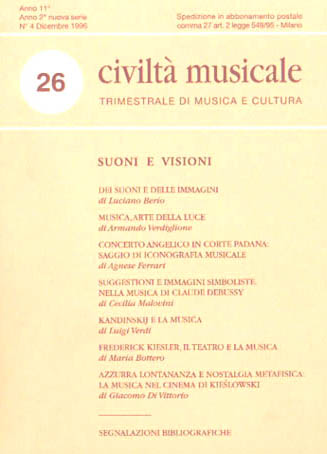
Kandinskij e la musica, in “Civiltà musicale”, 26, 1996, pp.59-90.
 After
finishing his University studies in Law and specializing in Political Economy,
when Kandinskij was about thirty years old he decided to devote himself
completely to painting; ever since he was young, he had studied music so that he
could play the cello and the piano quite well, while drawing and painting were
up to that time to him nothing but a pleasant pastime; in 1895 his artistic
sensibility was definitely stimulated by the discovery of impressionistic
painting, in particular of Claude Monet’s La Meule, and by the revelation of
the music of Richard Wagner’s Lohengrin: “Without even realizing it –
Kandinskij would write – the object intended as indispensable element of a
picture had been discredited. On the whole I had the impression that a small
part of my fairy-like Moscow was already existing on the canvas. On the contrary,
Lohengrin seemed to me a perfect realization of such Moscow. The violins,
the low basses and particularly the winds then embodied to me all the force of
that time early in the evening. I saw all my colours in my mind, they were in
front of my eyes; almost mad tumultuous lines were outlining in front of me”. After
finishing his University studies in Law and specializing in Political Economy,
when Kandinskij was about thirty years old he decided to devote himself
completely to painting; ever since he was young, he had studied music so that he
could play the cello and the piano quite well, while drawing and painting were
up to that time to him nothing but a pleasant pastime; in 1895 his artistic
sensibility was definitely stimulated by the discovery of impressionistic
painting, in particular of Claude Monet’s La Meule, and by the revelation of
the music of Richard Wagner’s Lohengrin: “Without even realizing it –
Kandinskij would write – the object intended as indispensable element of a
picture had been discredited. On the whole I had the impression that a small
part of my fairy-like Moscow was already existing on the canvas. On the contrary,
Lohengrin seemed to me a perfect realization of such Moscow. The violins,
the low basses and particularly the winds then embodied to me all the force of
that time early in the evening. I saw all my colours in my mind, they were in
front of my eyes; almost mad tumultuous lines were outlining in front of me”.
Kandinskij’s
Moscovite origin influenced his attitude as an artist in a determining way. It
is important to point out that Moscow represented to him the most perfect fusion
between sound and colour, according to an ideal which he would pursue all over
his life. In Ruckblicke (A look at the past), Kandinskij would note : “Moscow
blends in the sun, in a sketch which makes our inner hearts, our entire souls
vibrate like a mad tuba. No, this red evenness is not the most beautiful time!
It is only the final chord of the symphony which enlivens every colour intensely,
which makes Moscow resound like the fortissimo of a giant orchestra…”.
|
 |


