|

|
Domenico Alaleona im italienischen Musikleben des 20. Jahrhunderts, radio
programme broadcast by Westdeutscher Rundfunk of Cologne; German Translation by
Harald Münz (April 1997).
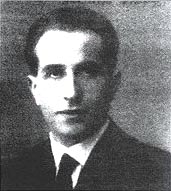 Born
in Montegiorgio, a small village in the south of Marche (central Italy) in 1881,
Alaleona belongs to that large group of composers who tried to renew the Italian
musical language at the beginning of 1900s, by linking the retrieval of
Gregorian chant and of Reinassance classical poliphony with the most recent
composing techniques, and by completely ignoring the Romantic experience. The
musical culture of that time was characterized by the lack of univocal
certainties and by the consequent search for identity on the part of the artists,
who were pursuing it towards different directions. The Italian musical panorama
was dominated by the veristic opera, but parallely some new interests in
Renaissance music were emerging, with the consequent revaluation of such figures
as Frescobaldi and Monteverdi. Alaleona started his musical studies when he was
a child, and then he entered the Conservatoire of Santa Cecilia, where he took
the courses of Composition with De Sanctis, of Piano with Bustini and Sgambati,
and of Organ with Renzi. He got the diploma in Composition in 1906 with the
oratorio Atollite portas and he graduated in Arts at the University of Rome with
a thesis on “Studies upon the history of the musical oratorio”, an
impressive important work which was published
in 1908. From those early years the essential character of Alaleona’s artistic
experience revealed itself, that is to say a wide humanistic culture at the
service of the musical art; in these terms, Alaleona represented the first Italian case of “musicologist-composer” , a role which
today is predominant in comparison with the past. His interest in choir music
led Alaleona to teach Choral chant at the Scuola Nazionale di Musica directed by
Mascagni, and then to the direction of the Società Corale Guido Monaco in
Leghorn (1907). From 1910 he was
director of the Coro dell’Augusteo in Rome. In the same years, Alaleona
started developing his “theory of the division of the octave in equal parts”,
which would find accomplishment in two important theorical writings appeared on
the Rivista Musicale Italiana in 1911: The modern horizons of musical technique.
Theory of the division of the octave in equal parts and Very Modern Harmony,
where , in his search for new linguistic codes and ethical horizons, Alaleona
foretold the intuitions of great Central European composers, as Schonberg,
arriving explicitly at theorizing dodecaphony. Born
in Montegiorgio, a small village in the south of Marche (central Italy) in 1881,
Alaleona belongs to that large group of composers who tried to renew the Italian
musical language at the beginning of 1900s, by linking the retrieval of
Gregorian chant and of Reinassance classical poliphony with the most recent
composing techniques, and by completely ignoring the Romantic experience. The
musical culture of that time was characterized by the lack of univocal
certainties and by the consequent search for identity on the part of the artists,
who were pursuing it towards different directions. The Italian musical panorama
was dominated by the veristic opera, but parallely some new interests in
Renaissance music were emerging, with the consequent revaluation of such figures
as Frescobaldi and Monteverdi. Alaleona started his musical studies when he was
a child, and then he entered the Conservatoire of Santa Cecilia, where he took
the courses of Composition with De Sanctis, of Piano with Bustini and Sgambati,
and of Organ with Renzi. He got the diploma in Composition in 1906 with the
oratorio Atollite portas and he graduated in Arts at the University of Rome with
a thesis on “Studies upon the history of the musical oratorio”, an
impressive important work which was published
in 1908. From those early years the essential character of Alaleona’s artistic
experience revealed itself, that is to say a wide humanistic culture at the
service of the musical art; in these terms, Alaleona represented the first Italian case of “musicologist-composer” , a role which
today is predominant in comparison with the past. His interest in choir music
led Alaleona to teach Choral chant at the Scuola Nazionale di Musica directed by
Mascagni, and then to the direction of the Società Corale Guido Monaco in
Leghorn (1907). From 1910 he was
director of the Coro dell’Augusteo in Rome. In the same years, Alaleona
started developing his “theory of the division of the octave in equal parts”,
which would find accomplishment in two important theorical writings appeared on
the Rivista Musicale Italiana in 1911: The modern horizons of musical technique.
Theory of the division of the octave in equal parts and Very Modern Harmony,
where , in his search for new linguistic codes and ethical horizons, Alaleona
foretold the intuitions of great Central European composers, as Schonberg,
arriving explicitly at theorizing dodecaphony.
Click here
to request the complete text (Italian version only)
|
 |


