|

|
Celibidache
e Bologna, edited by Luigi Girati and Luigi Verdi, Prefation by Silvia
Gajani, Bologna, Forni 2004, 217 pp.
Presentation: Foyer del Respighi, Teatro Comunale di Bologna, sabato 23 ottobre
2004
“Cominciammo a parlarne quattro anni fa [nel
2000]; io andai a casa di Luigi Girati che mi mostrò la sua documentazione su
Celibidache e poi me la diede a casa per studiarla un po’, raccomandandosi
dicendo che era materiale prezioso, che non avrebbe mai dato a nessuno
all’infuori di me. Ci rincontrammo qualche tempo dopo e stabilimmo di
raccogliere le testimonianze dirette di quelle persone che avevano conosciuto il
Maestro e avevano vissuto in prima persona le vicende della sua presenza a
Bologna. La maggior parte delle personalità da noi interpellate risposero con
piacere al nostro invito, contribuendo o con un testo scritto oppure
rilasciandoci un’intervista che poi abbiamo trascritto. Altra cosa importante
era anche l’indagine musicologica e gli apparati critici. Abbiamo preparato
l’elenco di tutti i concerti bolognesi di Celibidache, e trascritto tutte le
critiche apparse sui giornali bolognesi dell’epoca. E’ stato un lavoro piuttosto
lungo, perché poi si è trattato di selezionare i materiali, per evitare
ripetizioni e appesantire troppo i contenuti.
Un contributo importante ci è giunto anche da Alberto Spano che ha svolto un
lavoro prezioso sui materiali dell’Archivio Storico del Teatro Comunale di
Bologna, studiando le registrazioni sonore di concerti di Celibidache e curando
la trascrizione della conferenza stampa di un suo famoso corso per direttori
d’orchestra, che ebbe luogo nel 1972. Silvia Gajani, la moglie dell’architetto
dell’Accademia Filarmonica Roberto Fregna, ha poi scritto l’introduzione e,
grazie alla disponibilità dell’Editore Forni, il progetto si è potuto
realizzare. Debbo dire che nell’approfondimento della figura di Celibidache,
oltre la sua grandezza indiscutibile come direttore d’orchestra, si sono anche
confermati quegli aspetti ben conosciuti del suo carattere che lo avevano reso
sul posto di lavoro una persona 'antipatica' fra virgolette. È per questo
motivo, forse, che alcuni amici non hanno risposto al nostro invito di
contribuire a quest’omaggio, perché avevano ricordi umanamente non tutti
piacevoli”.
Review:
Musica e Scuola, XIX, 9, 2005, pp.16 (Piero
Mioli).
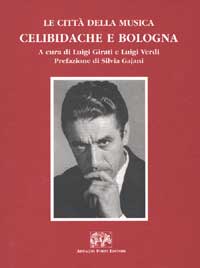 Orchestra
conductor Sergiu Celibidache more
than any others linked his name to the symphonic activity of the Teatro Comunale
of Bologna in the second half of the 1900s. A wide variety of anecdotes about
his presence in Bologna has flourished, also fostered by the brilliance of his
executions and by the unpredictability of his character. He is unanimously
considered as one of the most renowned interpreter of the 1900s and is closely
linked to Bologna, where he debuted as a conductor in 1953, and
contributed in a determining way to the increasing fame of the Teatro
Comumale Orchestra; the latter responded enthusiastically but not without
resounding clashes and tension, which resulted in his stormy abandoning the
podium in 1973. Fifty years after Celibidache’s Bolognese debut, some
historiographic research work seems to be necessary as to his Bolognese activity,
which also aims at clarifying and analysing the various phases of his presence
in the city, some of which are still surrounded by a halo of legend today. In
this view, the contributions of various personalities of the Bolognese musical
life who collaborated with Celibidache or witnessed those years (such as
Giovanni Adamo, Eugenio Amadori, Carlo Maria Badini, Maria Bagnoli, Mario
Baroni, William Bignami, Giorgio Combissa, Duilio Courir, Daniele Da Deppo,
Pierluigi Ghetti, Luigi Girati, Giuliano Giuliani, Tito Gotti, Dario Lodi, Leone
Magiera, Alberto Mantovani, Alberto Martelli, Enrico Quarenghi, Piero
Rattalino, Dario Ravetti, Giampaolo Salbego, Luciano Tamburini, Paolo
Varetti) have been collected . Some
of these contributions are colloquial and anecdotic, some other ones are more
historical and critical. My warmest thanks to all of them for having contributed
to giving us back a vivid and intense image of the great conductor. Orchestra
conductor Sergiu Celibidache more
than any others linked his name to the symphonic activity of the Teatro Comunale
of Bologna in the second half of the 1900s. A wide variety of anecdotes about
his presence in Bologna has flourished, also fostered by the brilliance of his
executions and by the unpredictability of his character. He is unanimously
considered as one of the most renowned interpreter of the 1900s and is closely
linked to Bologna, where he debuted as a conductor in 1953, and
contributed in a determining way to the increasing fame of the Teatro
Comumale Orchestra; the latter responded enthusiastically but not without
resounding clashes and tension, which resulted in his stormy abandoning the
podium in 1973. Fifty years after Celibidache’s Bolognese debut, some
historiographic research work seems to be necessary as to his Bolognese activity,
which also aims at clarifying and analysing the various phases of his presence
in the city, some of which are still surrounded by a halo of legend today. In
this view, the contributions of various personalities of the Bolognese musical
life who collaborated with Celibidache or witnessed those years (such as
Giovanni Adamo, Eugenio Amadori, Carlo Maria Badini, Maria Bagnoli, Mario
Baroni, William Bignami, Giorgio Combissa, Duilio Courir, Daniele Da Deppo,
Pierluigi Ghetti, Luigi Girati, Giuliano Giuliani, Tito Gotti, Dario Lodi, Leone
Magiera, Alberto Mantovani, Alberto Martelli, Enrico Quarenghi, Piero
Rattalino, Dario Ravetti, Giampaolo Salbego, Luciano Tamburini, Paolo
Varetti) have been collected . Some
of these contributions are colloquial and anecdotic, some other ones are more
historical and critical. My warmest thanks to all of them for having contributed
to giving us back a vivid and intense image of the great conductor.
Particularly relevant is also the whole text of the press-conference given by
the Maestro on the occasion of the Course in Orchestra Conducting held in
Bologna in 1972, and the analysis of Celibidache’s concert recordings kept by
the Archivio Storico (Archives) of the Teatro Comunale of Bologna, edited by
Alberto Spano.
Then, Celibidache’s activity as Chairman of the Accademia Filarmonica of
Bologna (1972-73) is gone over again through the analysis of the documents kept
at the Archivio Storico (Archives) of the Accademia.
The book ends with the complete list and with a wide press review of
Celibidache’s 50 Bolognese concerts, from the most important dailies from 1953
to 1973, particularly Il Resto del Carlino (articles by Leonello Levi, Duilio
Courir, Adriano Cavicchi), L’Avvenire d’Italia (G.M.Modonesi) and L’Unità
(Mario Baroni). The press review is supplemented with articles on Celibidache’s
returning to Bologna (1987) and with other important contributions, particularly
those appeared on the most important dailies on the occasion of the Maestro’s
death (August 1996) signed by some of the most relevant Italian music critics
(Piero Buscaroli, Angelo Foletto, Paolo Isotta, Leonardo Pinzauti).
A
rich store of photos and documents from the Archivio Girati completes the book,
which is a handy and enjoyable reading text both for music experts and fans.
Click
here for the complete (text
italian only)
|
 |


